Showing posts with label scotland. Show all posts
Wednesday, June 12, 2013
Sgian-dubh
The sgian-dubh is a small, singled-edged knife(Gaelic: sgian) worn as part of traditional Scottish Highland dress along with the kilt. It is worn tucked into the top of the kilt hose with only the upper portion of the hilt visible. The sgian-dubh is normally worn on the right leg, but can also be worn on the left, depending on whether the wearer is right or left-handed.
Originally, the sgian dubh is said to have been part of a set of knives used by servants or ghillie or gille(Gaelic: boy), as in serving boy to clean, skin and dress the meat after the Lord of the manor and his party had killed the game. One knife was long and heavy bladed(9 to 10 inches) for butchering the game. This larger knife is likely the ancestor of the modern dirk. The other of the set had a blade from 3 to 4 inches in length, this was for skinning the game. A skinning knife would have a straight single edged blade, or a clipped pointed blade (like a small bowie knife) with a handle of stag antler, or wood carved into interwoven bands of knotwork.
This brings us to the primary meaning of dubh (meaning black). Sometimes bog oak are used on the handle of these skinning knives—bog oak is dark brown to black in color. The secondary meaning, “hidden”, is at the root of sgian-dubh. It’s based on the stories and theories surrounding the knife’s origin, in particular those associated with the Highland custom of depositing weapons at the entrance to a house prior to entering as a guest. Despite this practice, a small twin edged-dagger, a mattucashlass (Gaelic: sgian-achlais /axLɪʃ/: oxter knife, [similar: anns an achlais, under the arms]) is concealed under the armpit—since in these far off days it was unsafe to be ever totally unarmed, not because he feared his host but rather because he feared intrusions from outside. Out of courtesy to his host, it’s removed from its place of concealment and placed where his host could see it, invariably in his stocking on the side of his hand.
The earliest known blades some of which are housed in the National Museum of Scotland in Edinburgh are made from German or Scandinavian steel which was highly prized by the Highlanders. The blades varied in construction, some having a “clipped” (famously found on the Bowie knife) or “drop” point. The “spear-point” tip has now become universal. Scalloped filework on the back of the blade is common on all Scottish knives.
Since the modern sgian-dubh is worn mainly as a ceremonial item of dress and is usually not employed for cutting food or self-defence, blades are often of a simple (but not unglamorous) construction.
Labels:
armpit,
Gàidhlig,
knife,
scotland,
scottish gaelic,
Sgian-dubh
Highland dirk
The Scottish dirk (“Highland dirk”, Scottish Gaelic: Biodag: dagger) is the traditional and ceremonial sidearm of the officers of Scottish Highland regiments. The development of the Scottish dirk as a weapon, beginning in the second half of the 17th century (during the Jacobite Rising), is a continuation of the 16th-century bullock/roundel dagger—narrow-bladed and the handle has the shape of bullocks.
Early dirk blades were long and single-edged with “gimping” of the blade spine, an effect that makes the spine of the blade look like it has dull saw teeth. The hilts were normally of wood, and the leather sheaths often contained pockets for by-knives and forks.
The earliest “traditional” dirks seem to appear shortly after the life of Oliver Cromwell ended in 1658. The knot-work carving on the grips became intricate with small studs appearing in the gaps of the knot-work. Blades of the old single-edge tapered form made solely for dirks still existed, though cut-down sword blades. This could be an early example of recycling for cost purposes, though most experts agree it was done more because the imported blades were better tempered than those of local manufacture. When present, pockets for by-knives and forks were also metal bound, however, rather than being carried side-by-side, the by-knife/fork pair began to be carried one beneath the other. Dirks of this form enjoyed their heyday for less than a century. The disaster at Culloden in 1745 led to prohibitions of wearing highland dress and accoutrements by those not in the army.
The final stages of the dirk show a marked change from the early weapons becoming “a dress accessory.” By the beginning of the nineteenth century, the shape of the grip changed from the more cylindrical form handed down by the bullock to a shape intended to represent the thistle, the floral emblem of Scotland. The studs in the knot-work were replaced with more fashionable nails and tacks of brass and silver, sometimes gilt. The carving on the grips also evolved (or degenerated according to some historians), moving from interwoven bands of knot-work to a style looking much like a basket weave. Fancier fittings for both grip and scabbard, often of silver, became even more common after 1800. Dirks of this late form were issued to Highland regiments after the ‘45.
Dirk Dance
Basket-hilted Sword
| A Scottish broadsword of the claidheamh cuil or ‘back-sword’ type. |
The basket-hilted sword was a heavy, broad, military sword developed the 16th century and remained in widespread use throughout the 18th century.
The Sinclair Hilt was one of the earliest basket-hilt designs. It’s believed that these swords were brought back to Scotland from Germany by George Sinclair’s mercenaries who had served there. They influenced the development of the Scottish basket-hilt sword, the claidheamh cuil—claidheamh meaning ‘sword’ and cuil meaning ‘back,’ so a ‘back-sword’. On average, the blade measured 38inches. It was given the nomenclature ‘back-sword’ because the sword was characterized by having a straight single-edged blade facing away from the open side of the hilt with a flat spine, and not to be interpreted as a sword worn on the back. Being easier and cheaper to make than the double-edged broadswords, back-swords became the favored sidearm of common infantry including the Highland Scots.
George Sinclair’s forces land in Norway, 1612. The soldier in the center is armed with a Sinclair hilt broadsword.
|
After the Jacobite Wars, the basket-hilted sword used by highlanders became a symbol of Scotland.
Historical evidence reveals that fencing practiced in Scotland was done with the Scottish basket-hilted broadsword during the 17th to 18th centuries. Scottish Fencing manuals detailing the use of the basket-hilted Scottish broadsword were published throughout the 18th century.
It has been suggested that certain Scottish Clans and families had specific training systems that were distinct from one another. For example, it is said that some members of Clan Macdonald were ambidextrous, and were thus able to fence with either left or right hand. The Kerr family is known in its family tradition to have predominantly left-handed swordsmen (as apparent in the construction of their castles), which has led to the term Kerr-Fisted.
Example manual
Match
“The Advantage of Shifting the Leg,” plate from Henry Angelo & Son’s Hungarian and Highland Broadsword (1799)
The term claymore is anglicized from the Scottish Gaelic claidheamh mòr (attested in 1772 as Cly-more) or "great sword" refers to the Scottish variant of the late medieval two-handed longsword. Authors argue that the basket-hilted sword (attested in 1773) is "incorrectly" called claymore have been known to suggest that claybeg (from a purported Gaelic claidheamh beag "small sword") should be used instead.
Labels:
back-sword,
basket-hilted sword,
claidheamh cuil,
fencing,
george sinclair,
germany,
jacobites,
scotland,
sinclair hilt,
swords
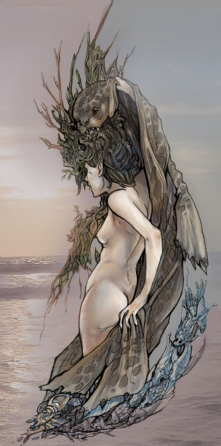
Selkie-Folk
When angels fell, some fell on the land, some on the sea.
The former are the faeries and the latter were often said to be the seals.
—Anonymous Orcadian
The former are the faeries and the latter were often said to be the seals.
—Anonymous Orcadian
Selkie is simply the Orcadian dialect word for "seal".
Some of the old folk claimed that the selkie-folk were, like fairies, fallen angels, condemned to live as animals until the Biblical Day of Judgement. Others insisted that the selkie-folk were once human beings who, for some grave misdemeanour, were doomed to assume the form of a seal and live out the rest of their days in the sea. The third possibility discussed by the Orcadian storytellers of yesteryear was that the selkie-folk were actually the souls of those who had drowned. One night each year these lost souls were permitted to leave the sea and return to their original human form.
There is no agreement as to how often the selkie-folk were able to carry out the transformation. Some tales say it was once a year, usually Midsummer's Eve, while others state it could be "every ninth night" or "every seventh stream". Regardless of how often they were able to transform, the folklore tells us that once in human form, the selkie-folk would dance on lonely stretches of moonlit shore, or bask in the sun on outlying skerries.
If this sealskin was lost, or stolen, the creature was doomed to remain in human form until it could be recovered. Because of this, if disturbed while on shore, the selkie-folk would hastily snatch up their skins before rushing back to the safety of the sea.
Some of the old folk claimed that the selkie-folk were, like fairies, fallen angels, condemned to live as animals until the Biblical Day of Judgement. Others insisted that the selkie-folk were once human beings who, for some grave misdemeanour, were doomed to assume the form of a seal and live out the rest of their days in the sea. The third possibility discussed by the Orcadian storytellers of yesteryear was that the selkie-folk were actually the souls of those who had drowned. One night each year these lost souls were permitted to leave the sea and return to their original human form.
There is no agreement as to how often the selkie-folk were able to carry out the transformation. Some tales say it was once a year, usually Midsummer's Eve, while others state it could be "every ninth night" or "every seventh stream". Regardless of how often they were able to transform, the folklore tells us that once in human form, the selkie-folk would dance on lonely stretches of moonlit shore, or bask in the sun on outlying skerries.
If this sealskin was lost, or stolen, the creature was doomed to remain in human form until it could be recovered. Because of this, if disturbed while on shore, the selkie-folk would hastily snatch up their skins before rushing back to the safety of the sea.
"As soon as the seal was clear of the water, it reared up and its skin
slipped down to the sand. What had been a seal was a white-skinned boy"
—George Mackay Brown - Pictures in the Cave
The selkie-men were renowned for their many encounters with human females — married and unmarried.
A selkie-man in human form was said to be a handsome creature, with almost magical seductive powers over mortal women. According to tradition, they had no qualms about casting off their sealskins, stashing them carefully, and heading inland to seek out "unsatisfied women".
Should a mortal woman wish to make contact with a selkie-man, there was a specific rite she had to follow. At high tide, she should make her way to the shore, where she had to shed seven tears into the sea.
The selkie-man would then come ashore and, after removing his magical sealskin, seek out "unlawful love".
The selkie-men were renowned for their many encounters with human females — married and unmarried.
A selkie-man in human form was said to be a handsome creature, with almost magical seductive powers over mortal women. According to tradition, they had no qualms about casting off their sealskins, stashing them carefully, and heading inland to seek out "unsatisfied women".
Should a mortal woman wish to make contact with a selkie-man, there was a specific rite she had to follow. At high tide, she should make her way to the shore, where she had to shed seven tears into the sea.
The selkie-man would then come ashore and, after removing his magical sealskin, seek out "unlawful love".
But while the males of the selkie race were irresistible to the island
women, selkie-women were no less alluring to the eyes of earth-born men.
The most common theme in selkie folklore is one in which a cunning
young man acquires, either by trickery or theft, a selkie-girl's
sealskin.
This prevents her from returning to the sea, leaving the seal-maiden with no option but to marry her "captor".
—orkneyjar
A traditional Scottish melody used to call the seals.
This prevents her from returning to the sea, leaving the seal-maiden with no option but to marry her "captor".
—orkneyjar
A traditional Scottish melody used to call the seals.
Scottish Sword Dances
The legend of the Scottish Sword Dance dates back to the 11th century about a Scottish prince named Maol Chaluim mac Dhonnchaidh, or Malcolm III, later nicknamed Malcolm Canmore, ‘Big Head’ which was used literally or in reference to his leadership capabilities. He was the eldest son of King Duncan I (Donnchad mac Crínáin [donyuh-hkuh mak kri-nah-n]) who ruled Scotland toward the end of 1034. The account was the original source to William Shakespeare’s Macbeth. Duncan’s reign was not successful as he was killed by Macbeth (Mac Bethad mac Findlaích/MacBheatha mac Fhionnlaigh [mak-veh-ha mak fionyuh-lahy]) on 15 August 1040. Although Shakespeare’s Macbeth presents Malcolm as a grown man and his father, an old one, it appears that Duncun was still young, and Malcolm was only 9 years old. Soon after the death of Duncan, his two young sons were sent away — exactly where is the subject of debate. One version had Malcolm sent to England and his brother, Donalbane (Domnall Bán [domnul bahn]), to the Isles. Another version had Malcolm’s mother take them both to the Orkney Isles, the Earl was an enemy of Macbeth’s family and Duncan’s kinsman by marriage. In 1045, Malcolm’s family attempted to overthrow Macbeth, but Malcolm’s grandfather Crínán of Dunkeld was killed in the attempt.
King of Alba (1058-1093) Malcolm and his second wife, Margret
An English invasion in 1054, chronicled the death of Macbeth by the commanding officer of the attack, Siward, and the death of a ‘Máel Coluim,’ but this proved to be inaccurate. Macbeth survived Siward by two years and Máel Coluim was then believed to be the son of the king of Strathclyde who married Duncan’s sister.
During the campaign, various chroniclers reported the death of Macbeth at Malcolm’s hand, on 15 August 1057 at Lumphanan in Aberdeenshire. On this occasion was when the legend was borne. In the wake of vengeance for his father, Malcolm III was said to have crossed his own bloody claymore (the two-handed broadsword of Scotland) over the bloodier sword of the defeated Chief and danced over the naked blades in triumph.
Others have suggested that warriors danced the Sword Dance the night before battle.
Either way, this dance of exultation became a tradition among the highland warriors, and in subsequent battles, clansman would cross their swords and dance around them in the same way. According to the clan tradition, if the dancer could complete the dance without touching the swords, it was a good omen that they would be victorious in the coming battle. However, to touch the swords beneath his feet during the dance was a bad omen and was indicative of doom for the coming battle.
There are many variations of the sword dance, but they do have common features. First, the dance is performed around and over two crossed swords (3, 4 or even 8 swords are used from time to time). Next, the dancer normally travels counterclockwise around the sword, and finally, the dance normally comprises of a slow strathspey time followed by quick reel time. Strathspey is named after that region of Scotland and so a type of country dance. It’s been hypothesized that strathspey mimics the rhythms of the Scottish Gaelic language.
In the first steps, the dancer performs are outside the sword, ‘addressing’ the sword. Subsequent steps are danced over the crossed blades. Once inside the blades, the dancer never turns his back to the swords - only a fool would turn his back on a weapon.
This unique form of Scottish Dance comprises almost entirely of one form of foot movement — the pas de basque and all other movements support it. Because this is, in essence, a war dance, all movements must be precise and strong, and the head should be proud and poised.
Highland Sword Dance Performance, solo performance.
Group performance, 1:30 into the video.
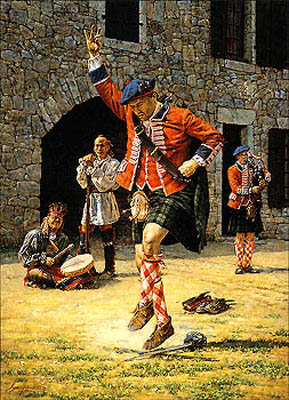
Beside the sword dance, there were the combative dances. Traditionally, these dances were taught to boys from a young age, along with other Highland weapons of war, the Lochaber axe, cudgel, dirk and targe. It was designed to drill simple, but effective methods of close combat skills including footwork that kicks, sweeps and trips, and throwing techniques. Unfortunately, many of the Highland combative dances with traditional weapons are now lost, but the Highland Dirk Dance (solo dance, starts at 2:40 of the video) still exists and was often linked to the sword dance or dances called Macinorsair, the ‘Broad Sword Exercise’ or the Bruicheath (Battle Dance). This combative dance, performed by two dancers in duelling form and as a solo routine, has the performers executing knife techniques combined with wrestling style kicks, trips and sweeps. Another version involved attacking and defensive techniques with single-sticks and targe shields. These battle dances resemble the Pentjak Silat [PENchahk SEElaht], a combative dance originating from Indonesia. —Wikipedia.
Since the Highland combative dances basically no longer exists and the Scottish battle dance was similar to the Pentjak Silat, I have posted the Pentjak Silat dances here.
1880. Indonesian warriors dressed in plain, white sarong.
Traditionally, sarongs are worn by both men and women and are plaid.
It’s possible these two warriors wore plain sarongs because it was
inexpensive, given they might be damaged during combat.
Pencak silat, also spelled penchak silat and pentjak silat is an umbrella term for the indigenous combat practice created in Indonesia. Pencak is the performance aspect of the traditional combat practice, while silat is the essence of the fighting and self-defense. The pencak silat tradition, very much like the Scottish Sword Dance tradition, was passed down almost entirely by word of mouth. The primary weapons of Indonesia’s tribal peoples were the straight, single-edge knife called the parang, not unlike the Scottish 18th century dirk, were used in more mundane situations rather than warfare—they were used to cut down forest brush. Like the Scottish sgian dubh to the dirk, the parang was accompanied by the bolo used to clear vegetation, and to kill and bleed pigs.
Performers. Samping/Linso: Piece of silk fabric worn around the
waist or shoulder, used in locking techniques and for defense against
blades. Stylized folds are in the front.
Basic steps and brief dance demonstration
Solo dance performance
Group performance In this video, note, though it is a group performance, parts of it are solo routines. When they do break up into pairs to duel, they demonstrate those kicks, sweeps and throws as explained above.
‘Waulking' the Tweed
Waulking is a finishing process that is applied to woven wool tweed. In Gaelic language, the process of waulking is called luadh (“loo-ugh”) and the songs of waulking are known as orain luaidh (“or-ine loo-ie”). There were four parts to the waulking process. The first, similar to the fulling process, entails shrinking the fabric so it thickens to give a degree of wind and waterproofing. Then cleansing the cloth, folding the cloth, the process of giving it tension, after which came a rite of consecration. Waulking was a daylong project and once begun it had to be finished in one session.
When cloth had been woven and removed from the loom, a session was planned. The waulking women assembled at the house of the owner of the cloth after breakfast. The tweed, up to 70 yards long, was sewn together at the ends to make a continuous loop and then it was soaked in human urine, fualor graith, which was saved in each house for this sole purpose. The ammonia served to deepen and intensify the dye colors but also to remove residual oils used to dress the wool.
Waulking of cloth was done by pounding the material against a board. Women would sit around the waulking board and the cloth would be pulled towards you and beaten on the board then passed slightly to your left before pushing it back, moving it in a four-time clockwise direction. Cloth would be inches narrower when the process was complete in addition to being softer, thicker, and more tightly woven.
Accompanying this work were waulking songs, òrain luiadh, a musical form unknown elsewhere in Western Europe. Waulking was measured by song - not time - it was never said, “it will take another half-hour” but rather “it will take another song”. The songs, which have common themes of love, war, hunting and sewing, are very rhythmic and were composed to keep the beat as the cloth was being waulked. The best singer, the ban dhuan, would sing out the verse and then everyone would join in the chorus. The verses and choruses (sometimes there are up to 4 choruses) are very short, sometimes only a few syllables.
Source
Scottish Wildcats, the Highland Tiger
“They’ll do anything to keep out of your way. When you corner them…and
they’ll have no where else to go, that’s when you have to watch out…”
—coffeefilms
Domesticated cats originate from the smaller African wildcat. The Scottish wildcats colonised Britain after the Ice Age over 9000 years ago. They followed the spread of suitable habitat and prey so that by the time Britain became an island, they spent a millennia in isolation. The British wildcats evolved to become what many consider to be a separate subspecies: Felis sylvestris grampia.
Due to the loss of forest habitat, hunting for their fur and persecution, by the late 19th century, wildcats in Britain were found only in remote parts of the Scottish Highlands and only there in very low numbers. They began to recover after the First World War, but by this time, domestic cats had become widespread and the principal threat that faces wildcats today - inter-breeding with domestic cats – began to take hold.
As a subspecies of the European wildcat, the Scottish wildcat is the largest and most powerful of all wildcats. It measures 47–66cm(18.5-26 in) in body length, 26–33cm(10in-13in) in tail length, and weighs 2.35-7.26kg(5.18lbs-16lbs). The wildcat is similar in appearance to a striped tabby cat, but has relatively longer legs and a more robust build. The wildcat’s fur is fairly uniform in length throughout the body, except for their tails. The hair on the tail is very long and dense, thus making it look furry and thick (Comparing a Scottish Wildcat to a hybrid or feral).
Apart from differences in genetics and temperament – wildcats are considered to be untameable, a trait not lost on Highland clans who adopted the animal as a symbol of ferocity and independence. The wildcat is considered an icon of the Scottish wilderness. The Picts venerated wildcats, having probably named Caithness (Land of the Cats) after them.
The Scottish wildcat has become rarer than the Bengal tiger. Experts believe there could be as few as 400 left in the wild. They have disappeared from England and Wales in the 19th century and it’s estimated that they will be extinct within the next ten years if no actions are made to preserve them (2006).
The voice of wildcats
Rumble and hiss. Grumpy cheetie.
BBC
Domesticated cats originate from the smaller African wildcat. The Scottish wildcats colonised Britain after the Ice Age over 9000 years ago. They followed the spread of suitable habitat and prey so that by the time Britain became an island, they spent a millennia in isolation. The British wildcats evolved to become what many consider to be a separate subspecies: Felis sylvestris grampia.
Due to the loss of forest habitat, hunting for their fur and persecution, by the late 19th century, wildcats in Britain were found only in remote parts of the Scottish Highlands and only there in very low numbers. They began to recover after the First World War, but by this time, domestic cats had become widespread and the principal threat that faces wildcats today - inter-breeding with domestic cats – began to take hold.
As a subspecies of the European wildcat, the Scottish wildcat is the largest and most powerful of all wildcats. It measures 47–66cm(18.5-26 in) in body length, 26–33cm(10in-13in) in tail length, and weighs 2.35-7.26kg(5.18lbs-16lbs). The wildcat is similar in appearance to a striped tabby cat, but has relatively longer legs and a more robust build. The wildcat’s fur is fairly uniform in length throughout the body, except for their tails. The hair on the tail is very long and dense, thus making it look furry and thick (Comparing a Scottish Wildcat to a hybrid or feral).
Apart from differences in genetics and temperament – wildcats are considered to be untameable, a trait not lost on Highland clans who adopted the animal as a symbol of ferocity and independence. The wildcat is considered an icon of the Scottish wilderness. The Picts venerated wildcats, having probably named Caithness (Land of the Cats) after them.
The Scottish wildcat has become rarer than the Bengal tiger. Experts believe there could be as few as 400 left in the wild. They have disappeared from England and Wales in the 19th century and it’s estimated that they will be extinct within the next ten years if no actions are made to preserve them (2006).
The voice of wildcats
Rumble and hiss. Grumpy cheetie.
BBC
Labels:
animal,
cats,
endangered species,
highland tiger,
scotland,
scottish wildcats
Subscribe to:
Posts (Atom)