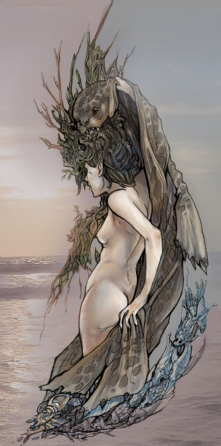
The Northman had many superstitions. He believed in good giants and bad giants, in dark elves and bright elves, in superhuman beings who tilled the wide gulf which existed between himself and the gods. He believed, too, in wraiths and fetches and guardian spirits, who followed particular persons, and belonged to certain families--a belief which seems to have sprung from the habit of regarding body and soul as two distinct beings, which at certain times took each a separate bodily shape. Sometimes the guardian spirit or fylgja took a human shape; at others its form took that of some animal fancied to foreshadow the character of the man to whom it belonged. Thus it becomes a bear, a wolf, an ox, and even a fox, in men. The fylgjur of women were fond of taking the shape of swans. To see one's own fylgja was unlucky, and often a sign that a man was "fey," or death-doomed...From the fylgja of the individual it was easy to rise to the still more abstract notion of the guardian spirits of a family, who sometimes, if a great change in the house is about to begin, even show themselves as hurtful to some member of the house. He believed also that some men had more than one shape; that they could either take the shapes of animals, as bears or wolves, and so work mischief; or that, without undergoing bodily change, an access of rage and strength came over them, and move especially towards night, which made them more than a match for ordinary men. Such men were called hamrammir, "shape-strong," and it was remarked that when the fit left them they were weaker than they had been before. This gift was looked upon as something "uncanny," and it leads us at once to another class of men, whose supernatural strength was regarded as a curse to the community. These were the Baresarks. What the hamrammir men were when they were in their fits the Baresarks almost always were. They are described as being always of exceeding, and when their fury rose high, of superhuman strength. They too, like the hamrammir men, were very tired when the fits passed off. What led to their fits is hard to say. In the case of the only class of men like them nowadays, that of the Malays running a-muck, the intoxicating fumes of bangh or arrack are said to be the cause of their fury. One thing, however, is certain, that the Baresark, like his Malay brother, was looked upon as a public pest, and the mischief which they caused, relying partly no doubt on their natural strength, and partly on the hold which the belief in their supernatural nature had on the mind of the people, was such as to render their killing a good work.
Again, the Northman believed that certain men were "fast" or "hard"; that no weapons would touch them or wound their skin; that the mere glance of some men's eyes would turn the edge of the best sword; and that some persons had the power of withstanding poison. He believed in omens and dreams and warnings, in signs and wonders and tokens; he believed in good luck and bad luck, and that the man on whom fortune smiled or frowned bore the marks of her favour or displeasure on his face; he believed also in magic and sorcery, though he loathed them as unholy rites. With one of his beliefs our story has much to do, though this was a belief in good rather than in evil. He believed firmly that some men had the inborn gift, not won by any black arts, of seeing things and events beforehand. He believed, in short, in what is called in Scotland "second sight". This was what was called being "forspár" or "framsýnn," "foretelling" and "foresighted ". Of such men it was said that their "words could not be broken"...This gift ran in families...
Source:
Preface of The story of Burnt Njal or Brennu-Njals Saga
Setting surrounding the story:
Kelder (home to Ingjaldur Hoskuldsson)
Gunnarssteinn: by Norðdahl, by
(where Gunnar Hamundarson lived)
Rauduskridur (Gunnar of Hlidarendi and Njall of Bergthorshvoll owned a forest there together)
Markarfljot (a glacial river south of Fljotshlid)
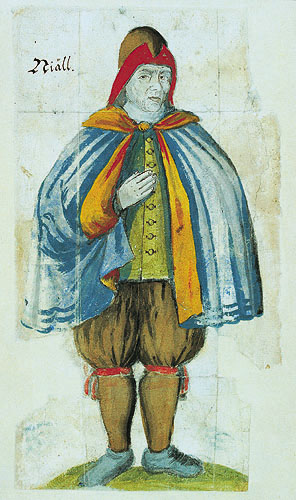
Bergthorshvoll (where Njall Thorgeirsson lived with his wife Bergthora Skarphedinsdóttir and their children)